

In 2023, recognizing the affordable housing crisis in the state, the Florida Legislature passed landmark legislation colloquially known as “Live Local” hoping to incentivize affordable housing and cut red tape. This new law preempts local governments on development applications if certain conditions are met. Key benefits include the ability to develop multifamily housing on parcels that have commercial, industrial and mixed-use zoning designations without the need to rezone or do a future land use amendment (lengthy processes) should the applicant include at least 40% affordable housing in the project. Affordable housing is defined as being at or below 120% Area Median Income. These projects are to be approved administratively, without the need for public hearings. Additionally, a qualifying applicant may obtain the highest density by right in the City/County and the highest height within a 1 mile radius of the site, with certain exceptions. 2024 amendments added in protections for single family homes/zoning districts and clarified that Floor Area Ratios are also preempted.
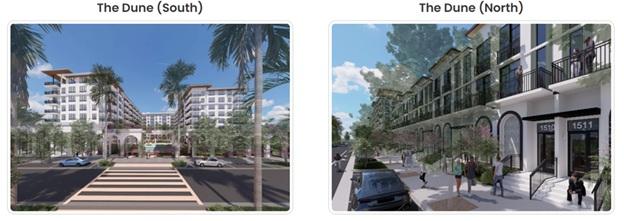 Live Local projects approved by Boynton Beach (The Dune South – 298 residential units & 2,595 sq. ft. of commercial space; The Dune North – 38 dwelling units)City of Boynton Beach
The following are recent changes that have been passed by both the House & Senate in relation to Live Local:
- Mandatory parking reductions for proposed developments increase from 10 to 15%;
- Requires demolition approvals for applications under this Act to be approved administratively, without the need for a public hearing;
- Clarifies that recreational uses, such as golf courses and clubhouses are not considered commercial, industrial or mixed-use for purposes of the Act;
- Effectively freezes the maximum height and density of a City for qualifying applications by providing that the maximum height, density and FAR are the higher of the law in effect as of July 2023 or anytime after that period (such that Cities cannot reduce their highest density by right via a downzoning);
- Includes Planned Unit Development zoning as long as they permit commercial, industrial or mixed-use;
- Authorizes local governments to approve affordable housing on parcels owned by religious organizations and containing a house of worship, as long as 10% of the units are affordable.
There is no magic wand to cure the affordable housing crisis, but it is clear that elected officials across the state have recognized the urgency and are proactively moving to address it.